

C004 Five-Port Electrochemical Cell
- PRODUCT DETAIL
C004 Five-Port Electrochemical Cell
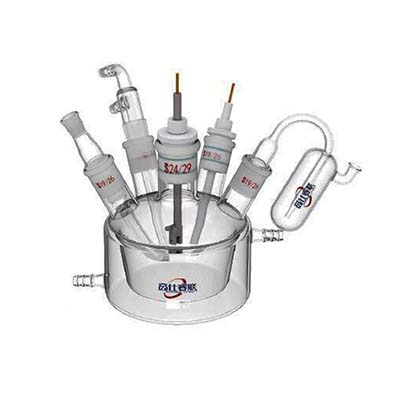
Product Introduction
The
C004 Five-Port Electrochemical Cell is designed for laboratory electrochemical
testing and research. Made with a high-borosilicate glass body, it features
five functional ports, an F-type gas inlet, a salt bridge, and a liquid-sealing
structure. The cell supports a three-electrode configuration and can be
customized to meet different experimental requirements.
Available
in single-layer and double-layer versions, the C004 can be configured for
standard electrochemical testing or temperature-controlled experiments. Its
relatively sealed design supports controlled-atmosphere testing, while the salt
bridge helps bring the reference electrode closer to the working electrode to
reduce solution resistance.
Performance Features
• High-Borosilicate Glass
Body: Provides a durable and chemically suitable vessel for laboratory
electrochemical experiments.
• Five-Port
Configuration: Includes the cell body, F-type gas inlet, salt bridge,
liquid seal, and PTFE plug.
• Flexible Electrode
Configuration: Commonly used with a three-electrode system; electrodes
can be selected and customized according to experimental needs. Matched
electrodes must have extended lengths.
• Compact
Cell Volume: Can be configured as a pointed-bottom cell with a capacity
of approximately 5–25 mL.
• Reliable
Sealing Structure: A ground-glass connection with an inverted
conical lid helps seal the cell. Electrode ports use sealing screws to compress
O-rings.
• Integrated Salt Bridge: Positions
the reference electrode closer to the working electrode, helping reduce
solution resistance.
• F-Type Gas Inlet: Supports
gas delivery both above and below the electrolyte surface for atmosphere
control. During testing, submerged gas delivery should be stopped once the
experiment begins, while above-surface gas flow is maintained.
• Two
Cell Options: The single-layer version is intended for standard
experiments; the double-layer version adds a water-jacket structure for
circulating temperature-controlled water.
Working Principle
The
C004 provides a controlled environment for electrochemical measurements using a
working electrode, reference electrode, and counter electrode. The potentiostat
applies or measures electrical signals through the electrode system to
investigate electrochemical reactions and material behavior.
The
salt bridge connects the reference electrode to the electrolyte environment
near the working electrode, helping minimize the distance between them and
reduce uncompensated solution resistance.
The
F-type gas inlet allows the atmosphere inside the cell to be adjusted according
to experimental requirements. Gas can be introduced above or below the liquid
surface. For the recommended test configuration, submerged gas flow is stopped
when measurement begins, while gas is supplied above the electrolyte to
maintain atmosphere protection.
The
double-layer version circulates constant-temperature water through the outer
jacket, helping maintain the electrolyte at a stable experimental temperature.
Technical Parameters
Parameter
Specification
Model
C004
Product
Type
Five-Port
Electrochemical Cell
Cell
Body Material
High-borosilicate
glass
Configuration
Cell
body, F-type gas inlet, salt bridge, liquid seal, PTFE plug
Electrode
System
Commonly
three-electrode; customizable
Electrode
Compatibility
Custom-matched
extended electrodes
Cell
Volume
Approx.
5–25 mL
Cell
Shape
Pointed-bottom
configuration
Lid
Structure
Inverted
conical lid with ground-glass joint
Electrode
Sealing
Sealing
screw with O-ring compression
Gas
Control
F-type
inlet for above- and below-liquid gas delivery
Sealing
Type
Relatively
sealed system
Available
Versions
Single-layer
and double-layer
Temperature
Control
Double-layer
version with circulating water jacket
Application Scenarios
The
C004 Five-Port Electrochemical Cell is suitable for:
• Three-electrode
electrochemical measurements
• Electrochemical
reaction and material research
• Electrode
characterization and performance evaluation
• Controlled-atmosphere
electrochemical experiments
• Inert-gas protection
and electrolyte deoxygenation procedures
• Temperature-controlled
electrochemical testing using the double-layer version
• Laboratory research in
chemistry, materials science, and corrosion studies
C004 vs. Conventional Electrochemical Cells
Comparison Item
C004 Five-Port Cell
Conventional Basic Electrochemical Cell
Port
Configuration
Five-port
functional configuration
Usually
simpler port arrangement
Electrode
Setup
Three-electrode
system with customization options
Depends
on cell design
Reference
Electrode
Integrated
salt bridge helps position it closer to the working electrode
May
have a less flexible reference-electrode arrangement
Gas
Control
F-type
inlet supports gas delivery above and below the liquid
Gas-control
capability varies
Sealing
Ground-glass
lid and O-ring electrode seals
Depends
on the sealing structure
Temperature
Control
Optional
double-layer water jacket
Often
requires an external temperature-control arrangement
Cell
Volume
Approximately
5–25 mL
Varies
by model
Frequently Asked Questions
1. What is the C004 Five-Port Electrochemical Cell used
for?
It
is designed for laboratory electrochemical experiments, particularly
measurements using a three-electrode system and tests requiring atmosphere
control.
2. What material is used for the cell body?
The
cell body is made of high-borosilicate glass, suitable for a range of
laboratory electrochemical applications.
3. Can the C004 be used with different electrode
configurations?
Yes.
It is commonly used with a three-electrode system, and electrode configurations
can be customized. Matched electrodes must have extended lengths to suit the
cell structure.
4. What is the function of the salt bridge?
The
salt bridge helps position the reference electrode closer to the working
electrode, reducing the distance through which the reference potential is
measured and helping lower solution resistance.
5. How does the F-type gas inlet work?
It
supports gas delivery both above and below the electrolyte surface. For the
recommended measurement procedure, stop gas delivery below the liquid surface
when the experiment starts and maintain gas flow above the liquid surface.
6. Is the C004 completely airtight?
No.
The C004 is a relatively sealed system rather than a fully airtight cell. When
used with a rotating disk electrode, the sealing effect cannot be achieved;
increasing the gas flow above the liquid surface is recommended to maintain
atmosphere protection.
7. What is the difference between the single-layer and
double-layer versions?
The
single-layer version is designed for standard electrochemical experiments. The
double-layer version includes an outer water jacket through which circulating
constant-temperature water can flow to regulate the electrolyte temperature.
8. What is the capacity of the C004 cell?
The
pointed-bottom configuration has a volume of approximately 5–25 mL.
9. How is the cell sealed?
The
inverted conical lid connects to the cell body through a ground-glass joint.
Electrode ports are sealed by screws compressing O-rings.
NEXT:C007-2 2H Absolutely Sealed Replaceable Membrane Electrochemical Cell


